I kept the fact that I was pregnant a secret for awhile. The thought of being treated delicately was not something I wanted when I was trying to prove myself. Although delightful, the surprise had me wondering how I'd balance my career as a cook with being a mother. Julia Child never got pregnant. Hmm.
I decided I would quit when I was six months pregnant. Meanwhile, rumors swirled and my bladder grew smaller. Time blew by, and, nervous as I was, I spoke to my chef about putting in my two weeks notice. She seemed disappointed, but not all that surprised, given the high turnover rate of employees.
"May I ask why you want to leave?" she said.
Unable to contain myself, I tearily explained that I didn't want to, but had to because I was pregnant. She hugged me and somehow(even though I secretly looked forward to days of lounging around) convinced me that I didn't necessarily need to quit.
I was relieved.
I continued to work as my belly expanded. Each week I went up a new uniform size: 34, 36, 38... On days when we were out of the larger pants, I had to make due with undone buttons and a makeshift belt made of plastic wrap (which poses a problem when you need to pee every fifteen minutes and you can't untie the darn thing).
My coworkers, some of the most awesome people ever, were nice enough to throw me a baby shower. The pastry girls baked the best cake I have ever tasted- and then refused to share the recipe! Very strange. I was told I could find it in the recipe book. Not so. Come to think of it, I also wanted this Lemon Basil Verbana sorbet recipe and never got it. =o|
Anyway, the best part about being pregnant and working the Garde Manger and Pastry stations was the unlimited access to made-fresh-daily ice creams. I took advantage of the whole being pregnant thing and milked it for all it was worth. I was frequently caught poking my head in the freezer to explore the ice cream selection. Once, the grill cook forgot to make a steak I had requested, and I looked down at my belly and patted it, saying, "It's ok, baby- no steak for us tonight..." to which everyone responded, "Awwww.." and I got my steak and then some.
That's not to say I didn't work my butt off. It was tough being on my feet- bending and lifting and waddling- when it already felt like I had a case of beer strapped to my abdomen. I hoped that all the exertion would force me into early labor, but quite the opposite happened.
Three weeks before I was due, I finally called it quits and spent the time resting up and showing my Mom around town. The due date came. And went. Ultimately, we had to induce labor. A whole day later, out came little(big) baby Max! He's the sweetest thing and I attribute that to my ample consumption of delicious ice cream.
Saturday, September 24, 2011

Thursday, September 8, 2011
I made this last night

The hardest part was waiting for the cake to cool so I could flip it over. I didn't have a lot of dark chocolate for the icing, so I substituted some milk chocolate. Thanks, http://www.joythebaker.com/ !
Monday, September 5, 2011
Cockadoodle Doo
It's been a long time coming since Culinary school.
Since then, I have:
As a result of my kitchen job, I had the supreme luck and honor of being able to cook for President Obama. I didn't get to meet him or even see him since security was so tight, and "cooking" for him is more of an overstatement, since I worked the cold station where hardly any cooking is involved. Nonetheless, I did get to help assemble some of his dishes. And also, when the evening was over, I took some sugar packets off of his table to add to my Presidential M&Ms souvenir. How's that for being a recent culinary grad? Not to mention six months pregnant!
While working at said restaurant- which, for the sake of preserving my job there(should I choose to go back), I won't name here- I learned an invaluable amount of things, which I'll share here. And, in addition to the prez, I got to cook for lot's of well-known folks.
I can cross cooking for Martha Stewart off my bucket list. As well as cooking for a handful of my culinary idols: David Chang, Eric Ripert, Daniel Boulud, and Wolfgang Puck.
I have seen what it's like to be in a kitchen where getting a New York Times rating means life or death. I never knew or guessed how much pressure there was. Food critics were treated like Gods. In the restaurant's early days, before the coveted review was published by the NYT, a cook was fired for serving undercooked chicken to a critic. The cooks were then given the mantra "check every chicken."
After we were accepted by the food world, it seemed like every night there were more than a few "VIP" tables, so the pressure began to wane.
Since then, I have:
- gotten married
- gotten a kitchen job
- had a baby!
- subsequently become a stay-at-home mom
As a result of my kitchen job, I had the supreme luck and honor of being able to cook for President Obama. I didn't get to meet him or even see him since security was so tight, and "cooking" for him is more of an overstatement, since I worked the cold station where hardly any cooking is involved. Nonetheless, I did get to help assemble some of his dishes. And also, when the evening was over, I took some sugar packets off of his table to add to my Presidential M&Ms souvenir. How's that for being a recent culinary grad? Not to mention six months pregnant!
While working at said restaurant- which, for the sake of preserving my job there(should I choose to go back), I won't name here- I learned an invaluable amount of things, which I'll share here. And, in addition to the prez, I got to cook for lot's of well-known folks.
I can cross cooking for Martha Stewart off my bucket list. As well as cooking for a handful of my culinary idols: David Chang, Eric Ripert, Daniel Boulud, and Wolfgang Puck.
I have seen what it's like to be in a kitchen where getting a New York Times rating means life or death. I never knew or guessed how much pressure there was. Food critics were treated like Gods. In the restaurant's early days, before the coveted review was published by the NYT, a cook was fired for serving undercooked chicken to a critic. The cooks were then given the mantra "check every chicken."
After we were accepted by the food world, it seemed like every night there were more than a few "VIP" tables, so the pressure began to wane.
Saturday, July 17, 2010
Level 3: Discipline: Skills For Consistency and Their Refinement
It was tough heading into a new level with a completely different instructor, Chef Nic. We had gotten used to the friendly camaraderie enjoyed with Chef Phil, who believed it wasn't necessary to beat down on the students who were paying his salary. Chef Nic, from the Eukraine, has a different approach.
And the Level 3 kitchen was not the bright shiny, stainless steel happy kitchen we were used to. The kitchen was one of the oldest, and notoriously the hottest in school. In Level 3, downstairs from our previous kitchens, there were no automatic toilet flushers, or automatic sinks. We had to remind ourselves to flush and turn the little knobs on the sink. There was no fancy filtered water cooler, like upstairs. We had one of those old school, straight from the tap, kindergarten water fountains. This would not be a part of the school toured by potential students. This was like a dungeon.
Level 3 would be all about making the same dishes over and over and over and over until we perfected them. Each dish had essential skills we needed to master, like searing a chicken, tourning cocottes, rolling perfect tart doughs, and turning out the classic bouef bourgignon.
After our first day in Level 3, Chef Nic really handed our rear ends to us, scoffing at the grades we had been given in our previous evaluations.
"I feel sorry for some of you because you will be really surprised when you're not receiving a 97 or a 98 anymore. Hah! A 97? I cannot believe this."
By the end of our first week, some of us questioned whether we belonged there. What the heck were we thinking, coming to this school with the idea that we might magically become expert chefs? I felt sorry for the wide-eyed kids I saw touring the library, and the beautiful student lounge. They had looks of wonder and awe, with their tour guide dropping names like, "Bourdain" and "Bouley". They had no idea it wouldn't be all rainbows and butterflies.
My grades dropped dramatically in Level 3, just like Chef Nic had warned. And he was right- I was surprised. I had no idea why it had happened because I continued to work harder than ever. He was trying to teach us a lesson. As much as I hated Level 3 and resented Chef Nic for treating us like idiots, I can look back now and be truly grateful for everything I learned. He was the only Chef who, on more than one occasion, handed out carrots and potatoes for us to take home to work on our knife skills. He was tough, and it was just what we needed.
Saturday, May 22, 2010
The Old Haven't-updated-in-awhile post/Sessions 24 - 36 of 120
It's been a good solid three and a half weeks since my last update. We're rounding out Level 2 and I can hardly believe it. Here's what I've failed to share with you:
Session 24/Egg Day:
We made eggs every which way: Scrambled, Poached, Over Easy, Omelets, Hard Boiled, Soft Boiled, etc.


Egg after egg after egg after egg. Chef Phil encouraged us to perfect our techniques, especially the French Rolled Omelet, which should be perfectly yellow without a single hint of brown. We went through at least two huge boxes of eggs.
Hundreds of eggs! And if you didn't stuff your face with them, they went into the Compost bin. I tried at least five times to make the perfect Over Easy eggs. Never in my life have I ever accomplished flipping them without breaking the yolk, and Egg Day was no exception.
The ironic thing is that I'm trying to start interning in the school's restaurant for brunch soon. Eh, we'll see how that goes.
Session 25/Tart Day:
Pear and Apple Tarts

What better way to follow a day of eggs than with the start of our pastry sessions? My partner and I had a successful first day of pastries. He confessed to me that he secretly wished he could be a pastry chef and preferred baking to anything.
Our tarts came out great except that the crust was just a little undercooked due to our rushed blind baking. Still, they came out looking quite stunning.
Session 26 - 31/Cakes, Crepes, Doughs, Souffles

I quickly learned that you can't really "wing it" when it comes to baking. I didn't incorporate enough air(by beating) in my little cake, and I also didn't allow it to bake long enough, so it came out with a gooey center and didn't rise too well. I tried to cover this up with extra frosting, but ended up spreading cake crumbs all over, so I covered the frosting up with cocoa powder. Uhh.. overkill?
Also, a clever classmate of mine asked, "Why'd you put a pretzel on your cake?" Hah, funny.

Crepes were fun, and I found them to be easier than pancakes. I always thought they'd be complicated, but since they're so thin, they're easy to monitor.
I wish I had pictures of our fruit tarts. Everyone's came out pretty- like something you'd see at a hotel's dessert buffet. Oh, and Eclairs! Who knew they'd be so simple? I'd probably never make them at home, but still, I am now less impressed with Dunkin Donuts.


Sessions 32 - 35/Nutrition and Food Costing:
Not a lot of cooking went on during these sessions. Just a whole lot of lecture time and note taking.
A few tidbits:
Session 36/Plating Styles:
We talked a lot about different menu designs(From prix fixe to a la carte) and plating styles. The general rule of thumb is to keep one-third of the plate visible when plating. It seems like a tactic to rip people of their money, but it's actually a lot more pleasing to the eye. A good example of a crowded plate is my Nicoise Salad from my previous entry.
We were given the chance to create our own dish using Flounder. I wanted to make something Guam-inspired and settled on a dish that wasn't so much Guam as it was tropical. It was a citrus-marinated flounder with a roasted pepper, mango, and avocado salsa, and a pineapple and coconut rice. It was deeelicious, but you'll have to take my word for it because Chef Phil didn't taste any of the dishes. His main concern was our plating style. He suggested I brush my fish with a little olive oil next time to counteract it's dryness. And there was also too much rice for the amount of fish on the plate. Otherwise it wasn't too crowded and was well-plated.
Session 24/Egg Day:
We made eggs every which way: Scrambled, Poached, Over Easy, Omelets, Hard Boiled, Soft Boiled, etc.

Egg after egg after egg after egg. Chef Phil encouraged us to perfect our techniques, especially the French Rolled Omelet, which should be perfectly yellow without a single hint of brown. We went through at least two huge boxes of eggs.
Hundreds of eggs! And if you didn't stuff your face with them, they went into the Compost bin. I tried at least five times to make the perfect Over Easy eggs. Never in my life have I ever accomplished flipping them without breaking the yolk, and Egg Day was no exception.
The ironic thing is that I'm trying to start interning in the school's restaurant for brunch soon. Eh, we'll see how that goes.
Session 25/Tart Day:
Pear and Apple Tarts
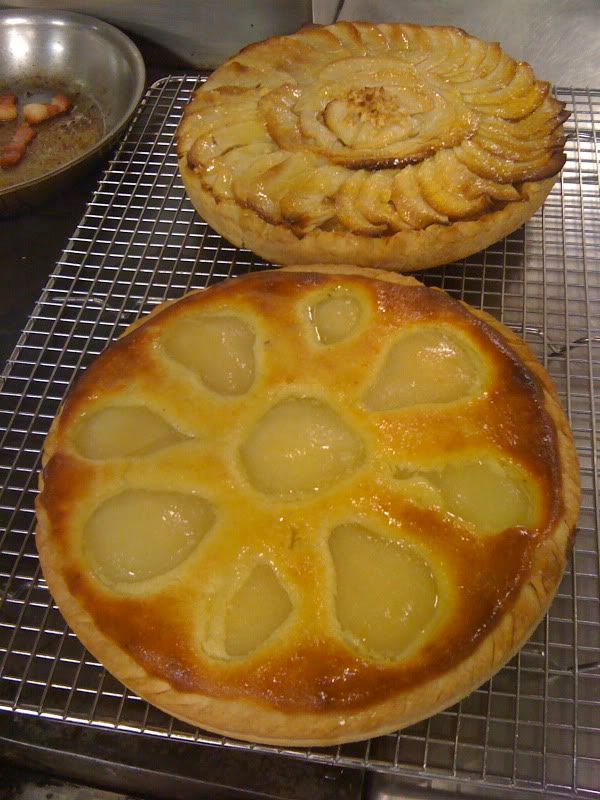
What better way to follow a day of eggs than with the start of our pastry sessions? My partner and I had a successful first day of pastries. He confessed to me that he secretly wished he could be a pastry chef and preferred baking to anything.
Our tarts came out great except that the crust was just a little undercooked due to our rushed blind baking. Still, they came out looking quite stunning.
Session 26 - 31/Cakes, Crepes, Doughs, Souffles
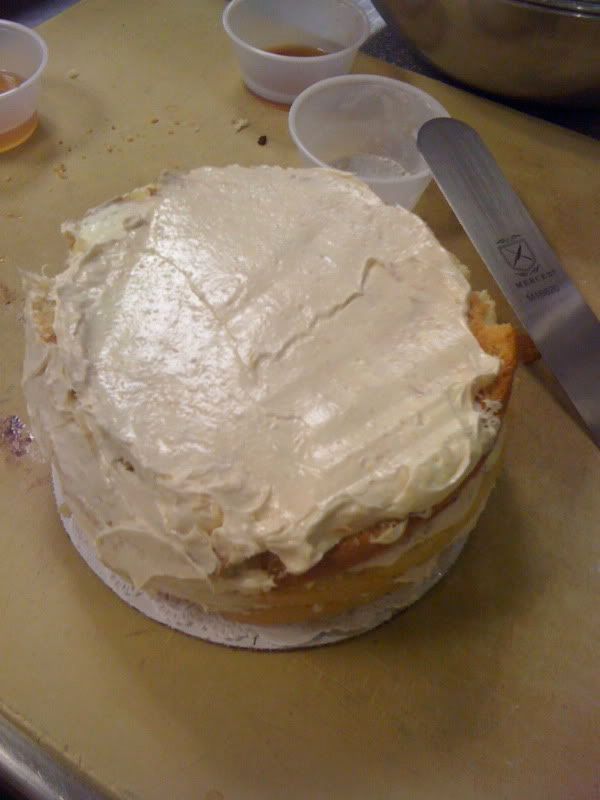
I quickly learned that you can't really "wing it" when it comes to baking. I didn't incorporate enough air(by beating) in my little cake, and I also didn't allow it to bake long enough, so it came out with a gooey center and didn't rise too well. I tried to cover this up with extra frosting, but ended up spreading cake crumbs all over, so I covered the frosting up with cocoa powder. Uhh.. overkill?
Also, a clever classmate of mine asked, "Why'd you put a pretzel on your cake?" Hah, funny.
Crepes were fun, and I found them to be easier than pancakes. I always thought they'd be complicated, but since they're so thin, they're easy to monitor.
I wish I had pictures of our fruit tarts. Everyone's came out pretty- like something you'd see at a hotel's dessert buffet. Oh, and Eclairs! Who knew they'd be so simple? I'd probably never make them at home, but still, I am now less impressed with Dunkin Donuts.
 |
 |
 |
 |
Sessions 32 - 35/Nutrition and Food Costing:
Not a lot of cooking went on during these sessions. Just a whole lot of lecture time and note taking.
A few tidbits:
- Cheese loses its lactose after 60 days. This explains why I get super gassy from fresh mozzarella, and not from aged parmesan.
- A great natural sugar substitute for diabetics is Stevia, made from plants, and not chemicals, like Equal and Sweet N Low.
- America consumes a ratio of 20 Omega-6 fatty acids for every Omega-3. Cultures known for long life spans consume a ratio of about 3 to 2. Do yourself a favor and add nuts, seeds, and leafy greens to your daily diets.
- Corn is high in Omega-6's, so anytime you can, choose to eat grass fed meats, which are high in Omega 3's.
- Chicken skin is very monounsaturated, which means it's a good fat, like olive oil.
Session 36/Plating Styles:
We talked a lot about different menu designs(From prix fixe to a la carte) and plating styles. The general rule of thumb is to keep one-third of the plate visible when plating. It seems like a tactic to rip people of their money, but it's actually a lot more pleasing to the eye. A good example of a crowded plate is my Nicoise Salad from my previous entry.

We were given the chance to create our own dish using Flounder. I wanted to make something Guam-inspired and settled on a dish that wasn't so much Guam as it was tropical. It was a citrus-marinated flounder with a roasted pepper, mango, and avocado salsa, and a pineapple and coconut rice. It was deeelicious, but you'll have to take my word for it because Chef Phil didn't taste any of the dishes. His main concern was our plating style. He suggested I brush my fish with a little olive oil next time to counteract it's dryness. And there was also too much rice for the amount of fish on the plate. Otherwise it wasn't too crowded and was well-plated.
Saturday, April 24, 2010
Day 23 of 120: Organ Meats. Mmm.
I'm not a big fan of liver, I realized. It has that weird aftertaste that makes me want to vomit just thinking about it. And kidneys, too, have that livery flavor. I thought I was an adventurous enough eater that I could appreciate things like liver and kidneys, but no. I'd be fine if I never ate them again. Chef Phil wagered that you probably have to grow up eating the stuff to like it. He might be right. The only liver I ever had growing up was from the bag of gizzards my dad used to throw on the grill when he barbecued chicken. And those were just small enough and soaked with marinade that I never got the sting of that liver flavor.
Kidney


Tongues, feet, and sweetbreads, although not really organs, all fall into the organ category for cooking. I can appreciate tongue. I think it's one of those things that should be served alongside all other meats at restaurants. It's really soft and tender when cooked right, and I think just the fact that it's tongue, grosses people out. I first had cow tongue prepared by Omar's grandma a couple of years ago. His family watched expectantly as I tried it, thinking I'd gag and wonder why they'd eat such a thing. I actually really enjoyed it and now anytime I see it on a menu, I get it. Especially in tacos! Mm!
Lamb Tongue


Unfortunately we didn't get to play with any feet in class. I'm really curious about pig's feet and chicken feet and don't remember ever trying them. We did have sweetbreads, though. They're actually an animal's thymus gland, and how they came to be known as "sweetbreads" is sort of a mystery. We made sweetbreads from calves, which tend to be larger because they shrink as the cow grows.

Soft, gelatinous, but with no weird aftertaste. We strayed from the book when we cooked them, covered in panko bread crumbs and pan fried. Yum!
After all the organ cooking, we had time to practice tournage. And my partner had enough time to carve this cute little potato penguin:

Kidney
Tongues, feet, and sweetbreads, although not really organs, all fall into the organ category for cooking. I can appreciate tongue. I think it's one of those things that should be served alongside all other meats at restaurants. It's really soft and tender when cooked right, and I think just the fact that it's tongue, grosses people out. I first had cow tongue prepared by Omar's grandma a couple of years ago. His family watched expectantly as I tried it, thinking I'd gag and wonder why they'd eat such a thing. I actually really enjoyed it and now anytime I see it on a menu, I get it. Especially in tacos! Mm!
Lamb Tongue
Unfortunately we didn't get to play with any feet in class. I'm really curious about pig's feet and chicken feet and don't remember ever trying them. We did have sweetbreads, though. They're actually an animal's thymus gland, and how they came to be known as "sweetbreads" is sort of a mystery. We made sweetbreads from calves, which tend to be larger because they shrink as the cow grows.
Soft, gelatinous, but with no weird aftertaste. We strayed from the book when we cooked them, covered in panko bread crumbs and pan fried. Yum!
After all the organ cooking, we had time to practice tournage. And my partner had enough time to carve this cute little potato penguin:
Sunday, April 18, 2010
Level 2 Session 2/day 22 of 120
I spoke to my mom last night and she said I needed to clean up my blog and "take out all the cusswords." She also asked if I knew the difference between "a" and "an." Hehe. So, I went back and edited and out of respect for her and in an effort to be professional, I promise to keep it clean.
Day 22 was all about forcemeats, pates, and gallontines. Or, in English: mashed up meats and tasty bits which we then spread over buttery toast, or rolled up in even more meat which we pounded thin.
Thinking there would be no family meal(buffet-style food served to students), my partner and I feasted on our stuffed meat and vegetables. We even had food to spare, which we promptly packed away to take home. I love bringing Omar things we might otherwise never try.
As we were cleaning our stations for break, family meal rolls in. And who could resist mashed potatoes and meat loaf wrapped in bacon? I made myself a plate and ate until I was sure the elastic would rip from my pants. And then Maria decided to share some of her sliced cucumbers drizzled with lemon juice and sprinkled with chili powder. I couldn't have just one.
Then, while we were all stuffed, we realized we had a lot of time to spare before class started again. My partner filled a pot with sugar, melted it down, and I think he mixed in milk, and something else. What resulted was the best, creamiest caramel ever. On Chef Phil's table, there were two unattended Granny Smith apples. We borrowed one and proceeded to dip crunchy apple slices in the delicious caramel. Food coma heaven.
When class finally started again and I thought my gluttony could not reach another level, Chef Phil offered us pieces of Futo-maki. And then we sauteed chicken livers with shallots and pureed them to make a pate, which of course I had to try. I'm surprised I didn't regurgitate from the horrendous amount of food I consumed.
Chicken Livers

Chef Phil introduced us to an ingredient called Activa. Made of transglutaminase, or in food terms, "meat glue," it is a naturally occurring enzyme that binds proteins together. Chef Phil said we could take shrimp and bind it to a piece of lamb, or take any two proteins and "glue" them together! So cool! It's the same ingredient that makes Chik'n McNuggets seem like real chicken and it's also used in imitation crabmeat. And, it's been outlawed in parts of Italy, possibly because of it's one dangerous effect: If you inhale the stuff, it can bind together the silica in your throat. Eek!
Day 22 was all about forcemeats, pates, and gallontines. Or, in English: mashed up meats and tasty bits which we then spread over buttery toast, or rolled up in even more meat which we pounded thin.
Thinking there would be no family meal(buffet-style food served to students), my partner and I feasted on our stuffed meat and vegetables. We even had food to spare, which we promptly packed away to take home. I love bringing Omar things we might otherwise never try.
As we were cleaning our stations for break, family meal rolls in. And who could resist mashed potatoes and meat loaf wrapped in bacon? I made myself a plate and ate until I was sure the elastic would rip from my pants. And then Maria decided to share some of her sliced cucumbers drizzled with lemon juice and sprinkled with chili powder. I couldn't have just one.
Then, while we were all stuffed, we realized we had a lot of time to spare before class started again. My partner filled a pot with sugar, melted it down, and I think he mixed in milk, and something else. What resulted was the best, creamiest caramel ever. On Chef Phil's table, there were two unattended Granny Smith apples. We borrowed one and proceeded to dip crunchy apple slices in the delicious caramel. Food coma heaven.
When class finally started again and I thought my gluttony could not reach another level, Chef Phil offered us pieces of Futo-maki. And then we sauteed chicken livers with shallots and pureed them to make a pate, which of course I had to try. I'm surprised I didn't regurgitate from the horrendous amount of food I consumed.
Chicken Livers
Chef Phil introduced us to an ingredient called Activa. Made of transglutaminase, or in food terms, "meat glue," it is a naturally occurring enzyme that binds proteins together. Chef Phil said we could take shrimp and bind it to a piece of lamb, or take any two proteins and "glue" them together! So cool! It's the same ingredient that makes Chik'n McNuggets seem like real chicken and it's also used in imitation crabmeat. And, it's been outlawed in parts of Italy, possibly because of it's one dangerous effect: If you inhale the stuff, it can bind together the silica in your throat. Eek!
Subscribe to:
Posts (Atom)
